The Buckskin Girl
She lay nameless for 37 years. A new science finally gave her back her name, even as the question of who killed her remains open.
The Case in One Sentence
The 'Buckskin Girl,' unidentified for 37 years after her 1981 murder near Troy, Ohio, was named in 2018 as Marcia Lenore King in what is widely cited as the first public identification by investigative genetic genealogy.
Who Was Involved
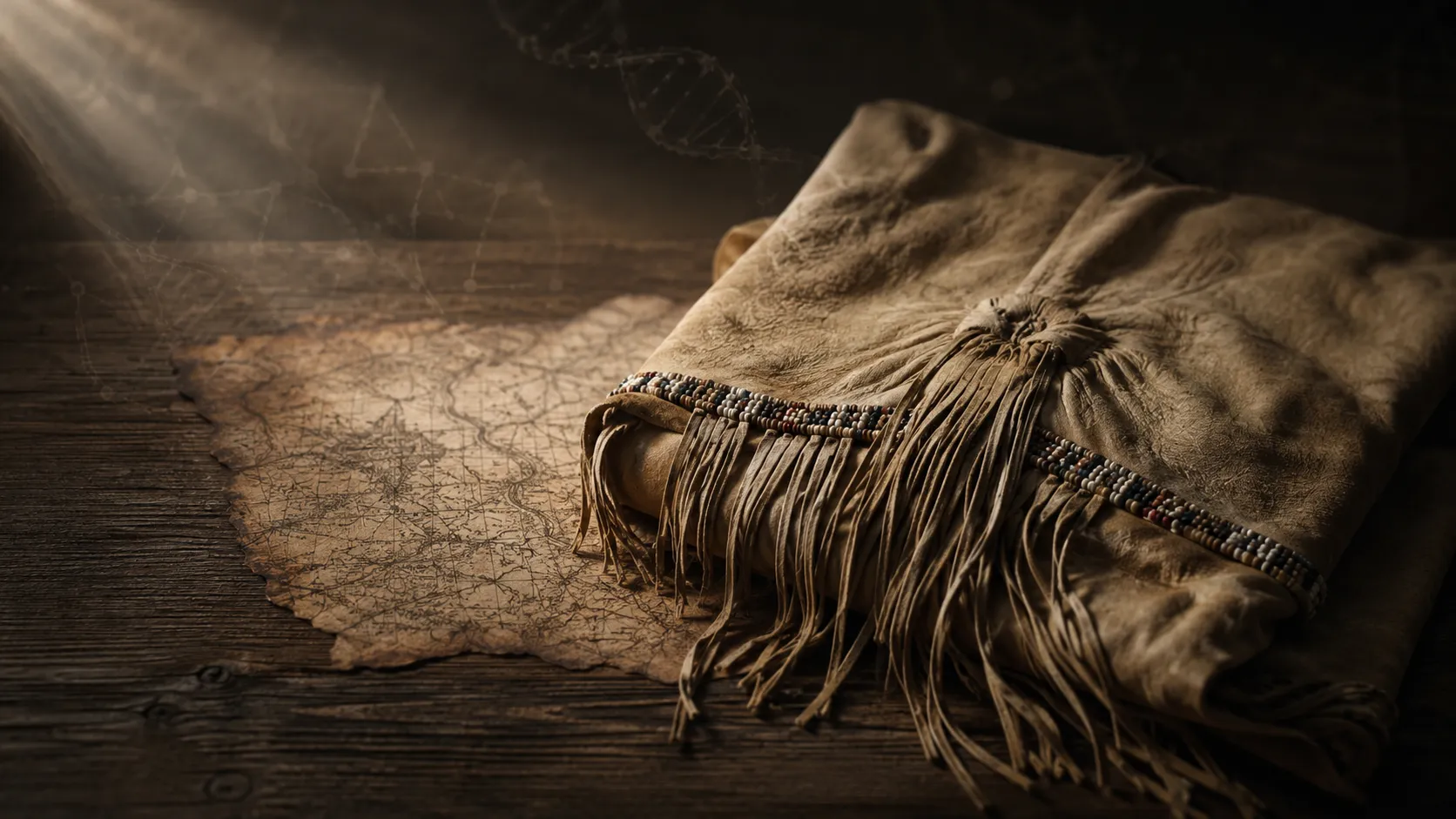
For nearly four decades she was known only by the clothing she died in. A young woman, slight and dark-haired, was found wearing a handmade tan poncho of fringed deerskin, and the people who tried to learn her name settled on the only one they had: the Buckskin Girl. She was a placeholder, a description standing in for a person. The real woman beneath it had a family, a hometown, and a life that had simply stopped being accounted for.
That woman was Marcia Lenore King, born in Arkansas in 1959. She was twenty-one years old when she died. According to the investigators and genealogists who eventually pieced her story together, she had left her Arkansas home around 1980 and was not heard from again. Somewhere along the way she traveled north, and somewhere in Ohio her path crossed that of the person who killed her. For the better part of forty years, her own mother reportedly kept the same home and the same telephone number, waiting for a daughter who would never call.
The other figures in this story arrived much later and never met her. They were forensic scientists, a county sheriff’s office, a forensic anthropologist, and a small group of volunteer genealogists working under the banner of a brand-new nonprofit. Together they would do something that had never been done in public before. They could not catch the person who took her life. But they could give her name back.
What Happened
In late April 1981, Marcia King’s body was discovered along a rural road west of Troy, in Miami County, Ohio. Reporting on the case places the discovery on Greenlee Road, and investigators believed she had been there only a short time before she was found. She had been killed. Out of respect for her and for her family, the specifics are best left where the coroner placed them; it is enough to say that her death was unmistakably a homicide.
She carried no identification. There was no wallet, no name, no obvious thread back to whoever might be missing her. What she did have was that distinctive poncho, hand-stitched from buckskin and fringed at the seams, unusual enough that police hoped someone, somewhere, would recognize it. They publicized the jacket. They waited. No one came forward.
And so a young woman who had been someone’s daughter became a case number and a nickname. She was buried under a marker that read simply Jane Doe.
The Investigation
The Miami County case did not go cold for lack of effort. Over the years, investigators returned to it with whatever tools the era offered. A facial reconstruction was produced and circulated in the hope that a likeness might jog a memory. Traditional DNA work was attempted more than once: a profile was developed through a regional crime laboratory in 2001, and another through a laboratory at the University of North Texas in 2009. Both profiles were uploaded to CODIS, the national DNA database used by law enforcement.
The trouble with CODIS is that it only helps if the person, or a close relative, is already in it, usually through prior contact with the criminal justice system. Marcia King was not. Neither, apparently, was anyone close enough to her to generate a match. The searches came back empty. She was also entered into the national missing and unidentified persons system, broadening the net, and still nothing connected.
By any conventional measure, the case had reached the end of its road. The standard methods, the ones that had quietly resolved so many other identifications, simply had nothing to grip. What was needed was not a better version of the old approach but an entirely different one.
The Breakthrough
That different approach arrived through the DNA Doe Project, a nonprofit founded in 2017 by Colleen Fitzpatrick and Margaret Press to apply genealogical methods to the unidentified dead. Their idea drew on the same consumer-style DNA tools that hobbyists use to find long-lost cousins, turned now toward the nameless.
The raw material was unpromising. The only usable biological sample was blood drawn after King’s death and stored for some thirty-seven years. The DNA had badly degraded, and more than one laboratory had reportedly concluded it was no longer useful. Working with specialists, the project managed to coax a workable genetic profile out of that aging sample and upload it to GEDmatch, a public database where users can compare DNA to build family trees.
What happened next became part of the lore of the field. Rather than seeking an exact match, the genealogists looked for relatives, distant cousins whose shared DNA could be triangulated back toward a common ancestor and, from there, forward to a single missing person. The work paid off with startling speed. As recounted by the project’s co-founder, the team found its answer in roughly four hours: a first cousin once removed, a family tree, and within it a relative named Marcia King who had gone missing and was presumed dead. Law enforcement then obtained a sample from a close family member, and a conventional comparison confirmed the identification.
In April 2018, the Miami County Sheriff’s Office, the county coroner, and the DNA Doe Project announced that the Buckskin Girl was Marcia Lenore King. The identification is widely cited as the first public use of investigative genetic genealogy to name a victim, arriving roughly two weeks before the far more famous Golden State Killer arrest brought the technique to national attention. As the forensic anthropologist Dr. Elizabeth Murray put it at the press conference, “This is not your run of the mill ‘DNA solves unidentified person.’”
Where the Case Stands Today
It is important to be precise about what was solved and what was not. Marcia King’s identity is solved. After thirty-seven years, she has her name, and a headstone bearing it has replaced the one that read Jane Doe. Her family, who had waited for decades, finally learned what had become of her, though that knowledge arrived with its own grief; her father had died only months before she was identified.
Her murder is not solved. No one has been arrested or charged in connection with her death, and the question of who killed her, and why, remains open. The Miami County Sheriff’s Office has continued to treat the homicide as an active investigation, and reporting indicates that detectives have pursued newer forensic techniques in the hope of developing leads. The agency has also signaled an intent to apply forensic genealogy to its other unsolved homicides.
So the file remains, in the truest sense, cold. The science that gave Marcia King her name did not, and could not, tell investigators who ended her life. That part of the story is still waiting to be written.
Why This Case Still Matters
The Buckskin Girl case matters first because of the woman at its center. For thirty-seven years she was a description on a poster. Restoring her name was not a technical footnote; it was an act of recovery, the difference between a body and a person, between an open question and a life that can finally be mourned by name.
It matters, too, because of what it began. The methods proven in this case, building family trees from distant DNA matches to identify the unknown, have since been used to name the dead and pursue the living in case after case across the country. What started as the first quiet success of a fledgling nonprofit working with a degraded vial of decades-old blood has become a standard instrument of cold-case work. Every later identification owes something to this one.
And it matters as a reminder of the work still unfinished. The same ingenuity that returned a name to Marcia King has not yet answered the harder question of who took her life. Naming her was the beginning of justice, not the end of it. The Evidence Room stays open in cases like this one, because a person identified still deserves a person held to account.
Source discipline
Sources & Further Reading
- Buckskin Girl case file DNA Doe Project
- Buckskin Girl press release DNA Doe Project
- 'Buckskin Girl' case: DNA breakthrough leads to ID of 1981 murder victim CBS News
- Blood Work: the citizen sleuth using genealogy to identify the dead California Magazine (UC Berkeley)
- Forensic genealogy may help solve cold cases in Miami County WHIO TV 7
Further Viewing
Further Viewing
New DNA technology identifies the 1981 Buckskin Girl victim · CBS News
CBS News on the 2018 identification of Marcia King, an early forensic-genetic-genealogy case.
Selected as supplementary viewing from an approved source. Case on the Case does not control third-party video content, and videos are supplementary, they do not replace the written sources above.
Keep reading
More from Solved Cold Cases

April Tinsley
Eight-year-old April Tinsley was abducted and killed in Fort Wayne, Indiana, in 1988. Her case stayed cold for thirty years, until forensic genetic genealogy finally identified her killer in 2018.

The Bear Brook Murders
How investigative genetic genealogy and a citizen sleuth finally gave names to four victims found in barrels in New Hampshire's Bear Brook State Park, decades after their deaths.

The Boy in the Box
How investigators, volunteers, and forensic genealogists spent 65 years restoring a name to Philadelphia's 'Boy in the Box,' identified in 2022 as Joseph Augustus Zarelli. His identity is now known; his murder is not.