The Black Dahlia
Decades of suspects, confessions, and theories have never produced a charge. The killing of Elizabeth Short is still officially unsolved.
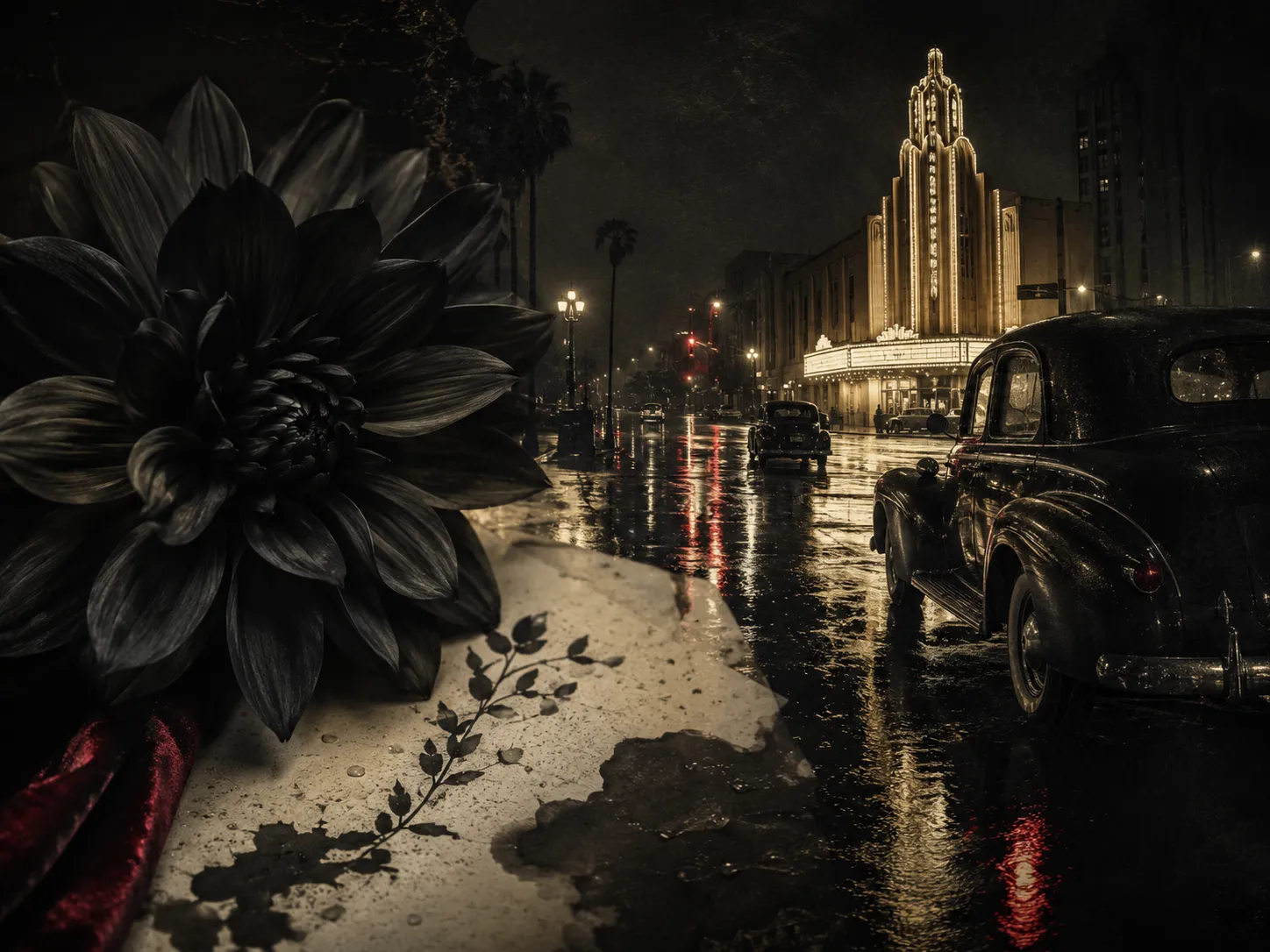
The Case in One Sentence
The 1947 Los Angeles murder of Elizabeth Short, a 22-year-old aspiring actress the press named the Black Dahlia, remains one of the most famous unsolved cases in American history.
Who Was Involved
Before she was a headline, she was a young woman a long way from home. Elizabeth Short was born in 1924 in Medford, Massachusetts, and like thousands of others in the postwar years she drifted toward Southern California with the vague, hopeful pull of the movies. She was 22 when she died. The names that would later attach themselves to her, the lurid descriptions, the nicknames, the theories, all came afterward, assembled by reporters and investigators who had never met her.
The press gave her the name the world still uses. Within days of the discovery of her body, newspapers were calling her the “Black Dahlia,” a label reportedly drawn from her dark hair and her preference for black clothing, and possibly echoing a film of the era. The nickname traveled faster and further than her own, and that fact alone says much about how the case was handled from the beginning.
On the other side of the story were the institutions that tried, and failed, to solve it. The Los Angeles Police Department led the investigation. The Federal Bureau of Investigation assisted, running records checks and conducting interviews across the country. Over the decades, a long line of detectives, journalists, and authors would take their turn at the file, and a long line of named suspects would pass through it, none of them ever charged.
What Happened
On the morning of January 15, 1947, a resident walking near a vacant lot on South Norton Avenue, in the Leimert Park area of Los Angeles, came upon the body of a young woman. The remains had been left close to the sidewalk in a deliberately posed manner, and the witness, by widely reported accounts, at first mistook the figure for a discarded mannequin.
The condition of the body became one of the most notorious features of the case, and it is enough to say plainly that the killing was exceptionally brutal and that the body had been deliberately mutilated. The forensic details that survive in the public record served one investigative purpose above all: they suggested that whoever did this had killed Short somewhere else and brought her there, and that the killer may have had some anatomical skill. That single inference would shape the hunt for years and lead investigators down avenues that produced no one.
What the killer left behind was a body and almost nothing else. There was little physical evidence at the scene to anchor the case, and Short herself proved nearly impossible to trace. She had moved frequently, worked rarely, and had known many people only briefly. Investigators were never able to establish with confidence where she had been in the days before her death.
The Investigation
The response was enormous. The LAPD mounted one of the largest investigations in the city’s history to that point, interviewing anyone who had crossed paths with Short and chasing leads across the country with the FBI’s help. Acting on the theory that the precision of the mutilation pointed to medical training, agents were asked to vet students at the University of Southern California’s medical school, one of many threads that led nowhere.
From the start the investigation was entangled with the press in a way that compromised it. Los Angeles newspapers, then in fierce competition, treated the case as a running spectacle, and the police at times worked in tandem with reporters, releasing details in hopes of shaking loose a suspect. The arrangement generated headlines and public tips, but it also muddied the record, encouraged sensational and unverified portrayals of Short, and made it harder to separate genuine evidence from noise.
The killer, or someone claiming to be, appeared to play to that same audience. About nine days after the body was found, an envelope reached the press and police containing Short’s address book, birth certificate, and other personal papers, along with a note assembled from cutout newspaper lettering. The envelope had been cleaned, and the fingerprints recovered from it were never of any use. Whether it came from the murderer or an opportunist has never been settled.
The Breakthrough
In a case like this, the honest account of the “breakthrough” is that none ever came. What came instead was a flood of false leads and false confessions that consumed the investigation and have never stopped.
The confessions began almost immediately and never really ended. Within weeks an Army veteran gave what investigators concluded was a demonstrably false confession, the first of dozens of people over the years who would claim responsibility for a crime they had not committed. Early suspects were detained and released for lack of evidence, among them the last man known to have been with Short before her death. None of it held.
The named-suspect theories that followed have been more durable in print than in court. The best known emerged decades later, when a former LAPD homicide detective publicly argued that his own late father, a Los Angeles physician, was the killer, a theory built on circumstantial material and disputed photographs. Other authors have pointed to a former mortician’s assistant, alleging a corrupt police cover-up, and still others to different figures entirely. It is essential to be precise here: every one of these men was a suspect or a theory, never a defendant. No one has ever been charged with the murder of Elizabeth Short, and the presumption of innocence belongs to all of them. The investigations and books have produced compelling narratives but no consensus and no proof.
Where the Case Stands Today
The killing of Elizabeth Short remains officially unsolved, and it is among the oldest open homicide cases in Los Angeles County. The likelihood that it will ever be closed by an arrest is, realistically, vanishing. Nearly everyone who could have been questioned is long dead, the physical evidence was thin from the outset and is now decades old, and the contemporary record is tangled with rumor that hardened into legend over three quarters of a century.
What survives is the paper trail and the public fascination. The FBI’s assistance to the LAPD between 1947 and 1948 was eventually declassified and released, and the case continues to draw fresh investigation from authors and researchers who reopen the old files and propose new culprits. So far, each new theory has joined the others as plausible argument rather than established fact, and the official status has not changed.
Why This Case Still Matters
Part of the answer is uncomfortable, and worth naming directly. The Black Dahlia case endures in part because the press turned a murdered young woman into a brand, and the brand outlived the person. The nickname, the noir mythology, the steady stream of novels and films, all of it has tended to obscure the basic fact at the center: a 22-year-old was killed, and her killer was never identified or held to account.
That is also why the case still instructs. It is an early, vivid example of how a sensational investigation can be distorted by its own publicity, how leaked details and competing newspapers can compromise the work, and how a person can be flattened into a legend. For an archive that tries to treat victims as people rather than spectacle, Elizabeth Short is a standing reminder of the difference, and of the obligation to keep the actual human being at the center of a story that has spent decades trying to forget her.
Source discipline
Sources & Further Reading
- Who Killed the Black Dahlia? HISTORY
- British Author Takes Fresh Look at the Black Dahlia Murder Smithsonian Magazine
- Black Dahlia murder (Research Starter) EBSCO Research Starters
- Top 10 Unsolved Crimes: The Black Dahlia TIME
- Lost LA: True Detective Helps in the Black Dahlia Case PBS
Further Viewing
Further Viewing
The search for the Black Dahlia's killer (From the Archives) · NBC Los Angeles (From the Archives)
An archival report from NBC's Los Angeles station revisiting the 1947 unsolved killing of Elizabeth Short.
Selected as supplementary viewing from an approved source. Case on the Case does not control third-party video content, and videos are supplementary, they do not replace the written sources above.
Keep reading
More from Famous Cases
BTK: Dennis Rader and the Floppy Disk
How investigators identified the Wichita serial killer who called himself BTK after a floppy disk he mailed in 2005 revealed hidden metadata pointing to a man named Dennis and a local church, ending a manhunt that spanned three decades.
Matthew Shepard
The 1998 killing of University of Wyoming student Matthew Shepard near Laramie became a national catalyst for hate-crime law, culminating in the 2009 federal Matthew Shepard and James Byrd Jr. Hate Crimes Prevention Act.
Kitty Genovese
The 1964 murder of Catherine 'Kitty' Genovese in Queens and the disputed '38 witnesses' narrative that gave rise to bystander-effect research, examined against the later corrections by The New York Times and scholars.