The Somerton Man / Tamam Shud
For decades he was simply the Somerton Man. In 2022, researchers said they had a name, though authorities still have not confirmed it.
The Case in One Sentence
A well-dressed man found dead on a South Australian beach in 1948, carrying a scrap of paper reading Tamam Shud, stayed nameless for more than seventy years until DNA pointed to a forgotten Melbourne engineer.
Who Was Involved
For seventy-four years he had no name. To the public, the press, and the police, he was simply the Somerton Man: a body, an open file, and a question that refused to close.
What was known of him came from the autopsy table and a few photographs. He was a fit, well-dressed man, found in a suit and polished shoes, with no wallet, no identification, and no obvious cause of death. Around him gathered a cast of investigators and obsessives who would spend their lives circling the case. The most persistent was Derek Abbott, a professor in electrical and electronic engineering at the University of Adelaide, who pursued the puzzle for the better part of two decades. In the final stretch he was joined by Colleen Fitzpatrick, an American forensic genetic genealogist known for putting names to the unidentified.
In 2022, the two researchers said the dead man was Carl “Charles” Webb, an electrical engineer and instrument maker born in 1905. If they are right, then the man at the center of one of the world’s most famous mysteries was, in the end, not a spy or an assassin, but a troubled Melburnian who had drifted out of his own life.
What Happened
On the morning of 1 December 1948, the body of a man was found propped against the seawall on Somerton beach, just south of Adelaide. He was lying as if asleep, head against the wall, legs crossed, a half-smoked cigarette near his collar. There were no signs of violence.
The autopsy only deepened the strangeness. His pupils were abnormally small, his spleen was enlarged to roughly three times its normal size, and his liver was congested with blood, all signs that pointed toward poisoning. Yet repeated tests on his blood and organs by an expert chemist failed to reveal the faintest trace of poison. The pathologist suspected a rare, fast-decomposing substance but could not prove it, and the cause of death was ultimately recorded as unknown.
His clothing had its labels carefully removed. A brown suitcase, traced to the Adelaide railway station cloakroom, told the same story: tags stripped from nearly everything, save for a few items bearing the name “Keane” or “T. Keane.” The case held an odd assortment of belongings, including a stencil kit and a coat stitched in an American style. Whoever he was, someone had taken pains to ensure he could not be identified.
The Investigation
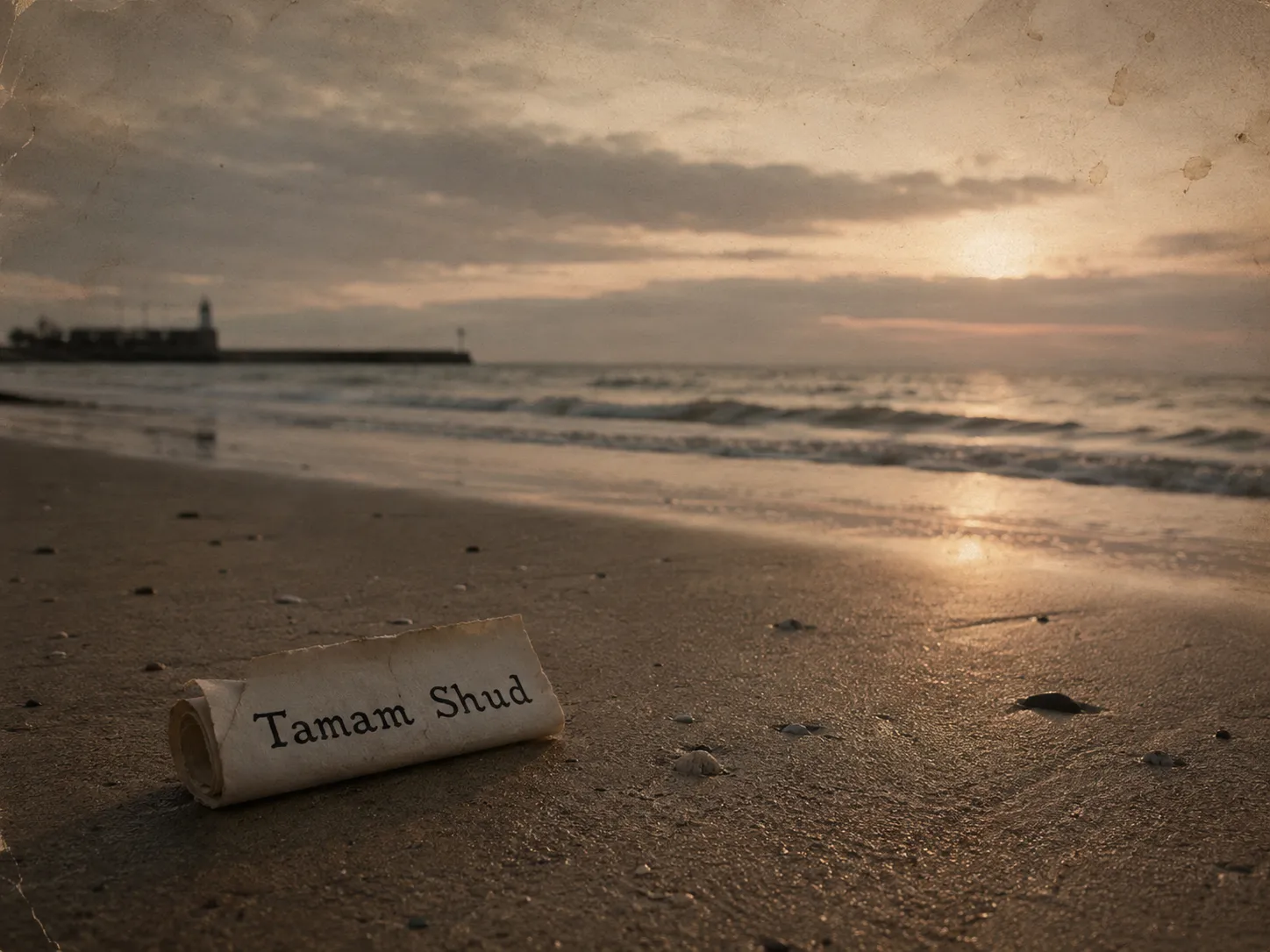
The clue that gave the case its name surfaced months later. Sewn into a hidden pocket in the man’s trousers was a tightly rolled scrap of paper printed with two words: “Tamam Shud.” The phrase is Persian, meaning roughly “it is finished,” and it forms the closing line of the Rubaiyat of Omar Khayyam, a beloved book of medieval verse.
A public appeal turned up the book itself. A man came forward with a copy of the Rubaiyat he said had been left in his car near the beach, and the torn final page matched the scrap exactly. Inside the back cover were two more riddles: a set of telephone numbers, and five lines of jumbled capital letters, one of them struck through, that looked for all the world like a code. Naval intelligence examined the lettering and concluded it did not constitute any simple cipher. The lines have never been broken.
The combination proved irresistible: an unknown body, a vanished identity, a poem about endings, and an unsolved code, all set against the early Cold War. From there the spy theory grew, fed by the era’s anxieties about Russia and espionage in the years just after the Second World War. It became the case’s most popular reading, and it remained, for decades, entirely unproven.
The Breakthrough
The answer, when it came, was not cryptographic but genetic. In the late 1940s, authorities had made a plaster death mask of the man, and strands of his hair had become embedded in the plaster. Years later, Derek Abbott obtained those hairs, and the University of Adelaide’s work to extract usable DNA from them stretched on for years.
The genealogy was its own marathon. Abbott and Fitzpatrick loaded the recovered DNA into the genealogical database GEDmatch, found a distant cousin, and from that thread built a family tree of some four thousand people. They then cross-referenced archival records to find a candidate whose life matched the few known facts. As Fitzpatrick put it, they could connect relatives to both his father’s and his mother’s lines, narrowing the field to a set of siblings, of whom Carl Webb was “the one with no documented death.”
The biography that emerged was quietly tragic. Webb was born in Footscray, a suburb of Melbourne, in November 1905, the youngest of several children. He married Dorothy Jean Robertson around 1941 and worked as an instrument maker. By 1947 he had left her, and the historical record of his life goes quiet. Divorce papers later described a moody, withdrawn man who wrote poems, many of them on the subject of death, which he is said to have called his greatest desire. The mysterious “Keane” labels found a mundane explanation too: Webb had relatives by that name, and the clothes were likely hand-me-downs.
Where the Case Stands Today
In May 2021, after years of petitions, the body was exhumed from Adelaide’s West Terrace Cemetery. The South Australian Attorney-General, Vickie Chapman, had granted approval, and South Australia Police carried out the work as part of Operation Persevere, the force’s effort to identify human remains in the state. Detective Superintendent Des Bray framed it plainly, noting that the dead man was somebody’s father, son, or brother, and that this was why the work mattered. Forensic scientists warned that the decades-old, embalmed remains might yield no usable DNA at all.
The official process and the researchers’ announcement have not yet met in the middle. When Abbott and Fitzpatrick named Carl Webb in July 2022, South Australia Police said they were cautiously optimistic that it might provide a breakthrough, while Forensic Science South Australia continued its own examination and declined to confirm the finding. As of the most recent reporting, that remains the situation: the identification is the work of independent researchers, accepted by many but not officially confirmed by the coroner or the police. The code in the Rubaiyat is still unread, and the precise cause and circumstances of his death are still, formally, unresolved.
Why This Case Still Matters
The Somerton Man endures because he sits at the meeting point of two very different stories. One is the romance the public built around him: the poem, the cipher, the secret pocket, the whisper of espionage. The other is the smaller, sadder human truth the science seems to be uncovering, of a man who slipped out of his marriage and his life and died alone on a beach far from home.
It is also a landmark in how the unidentified are given back their names. The same forensic genetic genealogy that has cracked open decades-old murder cases was turned here on a man with no suspect and no crime to solve, only an identity to restore. That a profile could be coaxed from hairs trapped in plaster for seventy years, then matched across a tree of thousands of strangers, is a measure of how far the tools have come. And the gap that remains, between what researchers believe and what authorities will certify, is itself the lesson: in a case this old and this strange, even a name arrives with an asterisk.
Source discipline
Sources & Further Reading
- Australia's Mysterious Somerton Man Identified as Carl Webb Smithsonian Magazine
- The Enduring Mystery of the Somerton Man, One of Australia's Most Puzzling Cold Cases Smithsonian Magazine
- For 70 years the identity of the Somerton man has been a mystery. His body is now being exhumed in search for answers SBS News
- Somerton Man exhumed in bid to end decades-old mystery InDaily (Solstice Media)
- Professor Derek Abbott, Researcher Profile University of Adelaide
Further Viewing
Further Viewing
Somerton Man identified as a Melbourne electrical engineer, researcher says · ABC News (Australia)
ABC News (Australia) on the 2022 announcement that researchers had identified the man, consistent with this article noting the identification is not officially confirmed.
Selected as supplementary viewing from an approved source. Case on the Case does not control third-party video content, and videos are supplementary, they do not replace the written sources above.
Keep reading
More from Famous Cases
BTK: Dennis Rader and the Floppy Disk
How investigators identified the Wichita serial killer who called himself BTK after a floppy disk he mailed in 2005 revealed hidden metadata pointing to a man named Dennis and a local church, ending a manhunt that spanned three decades.

Matthew Shepard
The 1998 killing of University of Wyoming student Matthew Shepard near Laramie became a national catalyst for hate-crime law, culminating in the 2009 federal Matthew Shepard and James Byrd Jr. Hate Crimes Prevention Act.
Kitty Genovese
The 1964 murder of Catherine 'Kitty' Genovese in Queens and the disputed '38 witnesses' narrative that gave rise to bystander-effect research, examined against the later corrections by The New York Times and scholars.